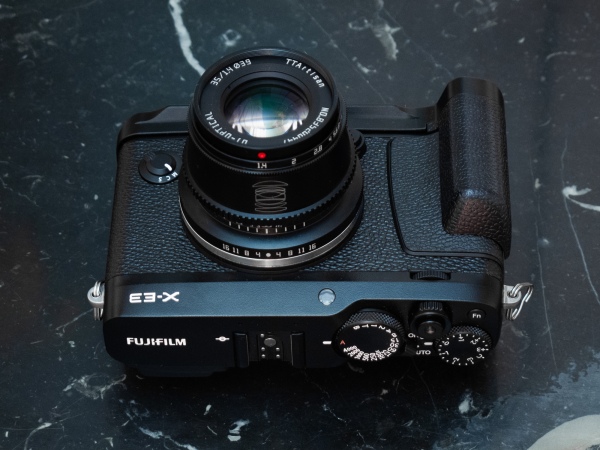
My christmas 2012 camera group shot

That’s the stuff that I currently use on a regular basis:

The small group shot.

The small group shot.

The big group shot.

The big group shot.

Here’s an old image of all my Pentax bits that I had collected and used during the winter 2006/2007. Sadly, the Pentax K10D camera body that I was shooting with at the time is missing on the picture:

Pentax stuff (spring 2007).

Pentax stuff (spring 2007).

OM Zuikos vs. Panasonic 45-200: Here’s the last E-M5 telephoto competition – for now :)

I just sold my Panasonic 45-200 – and before I let it go, I quickly set up a last competition between this and my two OM Zuiko lenses. So here you go – from the same position, same distance (about 3 metres), and with the same E-M5 body: First the OM Zuiko 135/2.8, then the 200/4 and Panasonic 45-200 at 200mm.

Every lens was shot at open aperture, that is: f/2.8 for the 135, f/4 for the 200, f/5.6 for the 45-200 zoom. The superior image quality of the two OM Zuikos over the zoom is clearly visible, right at maximum aperture. Note that there might be some really slight focus variations, but if you check out the complete frames in original size, you’ll notice that the sharpest image areas are just a bit crisper and nicer with the OM Zuikos.

Tiger. (OM Zuiko 135/2.8 af f/2.8)

Tiger. (OM Zuiko 135/2.8 af f/2.8)

Click for full-size image

Tiger. (OM Zuiko 200/4 af f/4)

Tiger. (OM Zuiko 200/4 af f/4)

Click for full-size image

Tiger. (Panasonic 45-200 at 200mm, f/5.6)

Tiger. (Panasonic 45-200 at 200mm, f/5.6)

Click for full-size image

We all know that the 45-200 is just a consumer-grade zoom and not meant to be compared with superb fixed-length telephotos, but then the two OM Zuikos in question are over 30 years old, they don’t come with aspherical elements and apochromatic colour correction, and they were never made to perform on a 16 megapixel Micro Four Thirds sensor. Also don’t forget the added convenience of a modern zoom lens with autofocus – this post is not meant to bash the 45-200. It, however, shows what kind of quality an old lens can deliver, even when it is that old.

As usual, these were shot RAW and converted with Lightroom, with absolut standard sharpness settings and a little bit noise reduction (20 on the scale from 0–100). For lightning, I used a bounced flash. While I boosted the contrast a little bit, I did so the exact same amount on all three shots. Read: All these three lenses show more or less the very same contrast level. To my eyes, a nice testimony to the quality of the “MC” coating on the old Zuikos.

That’s how an E-M5 looks with the OM Zuikos 200/4 and 135/2.8

I’m currently without any second digital camera, so I borrowed one to get these shots. If a new Olympus Pen with built-in viewfinder should ever appear, it could be a nice second body for me ;)

Anyway, you can see how much bigger the OM Zuiko 200/4 is over its smaller brother, the 135/2.8 – well, none of them are really huge, anyway. And don’t forget the reach that the 200 gives on the E-M5 – on a 24x36mm camera, you’d need a 400mm lens to match it.

E-M5 with OM Zuiko 135/2.8 MC.

E-M5 with OM Zuiko 135/2.8 MC.

E-M5 with OM Zuiko 200/4 MC.

E-M5 with OM Zuiko 200/4 MC.

Note that most OM Zuikos have their aperture ring placed up front on the barrel, in contrast to almost any other legacy SLR glass. It’s actually very ergonomic this way, especially on a mirrorless body: You hold the camera with your right hand and balance the lens with the left. Now, the aperture ring up front is much more convenient when you focus with the lens fully open and then quickly grab the aperture ring to close it down one or two clicks. With a conventional rear-mounted aperture ring, you’d loose balance when you grab it between focusing and taking the shot.

On conventional SLR cameras, this is not a big deal, as the lenses then would work with automatic stop-down aperture.

As to optical performance, here are some of my results of the OM Zuiko 135/2.8 and of the OM Zuiko 200/4.

A short walk through snow-covered Cologne

This is the first snow for 2012 in Cologne. Sadly, it’s normally not cold enough here for snow and just melts away within two or three days. But these pictures were taken the day after snowfall and it was very nice. Also it was an opportunity for me to take out my OM Zuikos 135/2.8 and 200/4 and see what I can get under real time conditions. The majority of pictures was taken with the Panasonic 20/1.7 and Olympus 45/1.8, though.

I’m genereally not into photographing action or fast-moving subjects – lucky me, because with anything that moves, I’m pretty hopeless with these manual-focus lens classics. I added a few data about the lenses used on some of the pictures below – so for those who should happen to read my blog just to watch photos: Please just ignore all the techno babble below ;)

View over Kehlgraben, Volksgarten, Cologne.

View over Kehlgraben, Volksgarten, Cologne.

A small shoot. (E-M5 with 20/1.7 at f/1.7)

A small shoot. (E-M5 with 20/1.7 at f/1.7)

I just love how the small Panasonic 20/1.7 delivers at full-open aperture. It’s not my favourite lens closed down, because you have to add so much Lightroom corrections to make it work properly, but wide-open, it’s just amazing!

The old fort in the Volksgarten, Cologne.

The old fort in the Volksgarten, Cologne.

A double fortification ring was built all around Cologne from 1815 onwards. It was finally dismantled right after WW I due to the Treaty of Versailles. But already in 1922, Konrad Adenauer, then Lord Major of Cologne, had the whole fort areas turned into two big park rings that circumferent the whole Cologne city center until today. Only very few of the old fort buildings remain and this is one of them.

Colours of snow II. (E-M5 with 45/1.8 at f/1.8)

Colours of snow II. (E-M5 with 45/1.8 at f/1.8)

Colours of snow. (E-M5 with 45/1.8 at f/1.8)

Colours of snow. (E-M5 with 45/1.8 at f/1.8)

I love the 45 even more than the 20, because it delivers wide-open and gets just perfect at around f/2.8 to f/4. Also it gives you plenty control over depth-of-field. What an achievement for such a small and light-weight lens!

Colours of ice. (E-M5 with OM Zuiko 135/2.8 at f/5.6)

Colours of ice. (E-M5 with OM Zuiko 135/2.8 at f/5.6)

In practice, the OM Zuiko 135/2.8 beats, in my opinion, its bigger brother 200/4 regarding overall image quality and versatility. This one equals “only” a 270mm lens in classic 35mm film terms, and in general photography, I find it just easier to handle than a whopping 400mm lens.

Also, the 200/4′s colour fringes can be disturbing even at f/5.6 – while the 135/2.8 gets about perfect at f/5.6, even though never showing the biting sharpness of the 45/1.8. Anyway, both these classics beat my Panasonic 45-200 hands-down regarding image quality.

Unicenter.

Unicenter.

The Unicenter is one of the biggest residential buildings in Europe. It’s 134 metres tall, still making no.27 on the list of tallest buildings in Germany. I hear you Americans and Hong Kong residents laugh, but skyscrapers never played a major role here in Germany, and especially regarding Cologne, there’s a lot of restrictions for the construction of tall buildings as an effort to keep the visual impact of the famous Cologne Dome over the skyline of the city. (As a side note, the Cologne Dome itself was the world’s highest building from 1880-1884 with 157 metres.)

For this image, I prefer the super-flat perspective that the 200/4 delivers on the E-M5. The 135 would be too short to give this kind of view. But it’s hard to get critical focus when hand-holding the whole thing – I need 14x magnification to really nail focus, and even with the built-in body stabilisation it’s hard to keep the subject steady enough to adjust focus in the viewfinder at this focal length. Let’s just hope that the firmware update that Olympus announced for December 2012 or January 2013 will bring a focus peaking feature with it which would greatly help focusing these lenses!

Gyrocopter. (E-M5 with 200/4 at f/8, 100% cropped image. It was far away!)

Gyrocopter. (E-M5 with 200/4 at f/8, 100% cropped image. It was far away!)

YI was barely able to see the tiny gyrocopter with my eyes – that it was a gyrocopter, in fact, was just visible in the viewfinder for me. This is a 100% crop of the image, taken at 200mm focal length. It’s not really what I’d call a good photo, but it does give an idea of what the old 200mm lens still can deliver on the E-M5.

Fallen leaves. (E-M5 with OM Zuiko 200/4 at f/4)

Fallen leaves. (E-M5 with OM Zuiko 200/4 at f/4)

I also love this shot for the lighting, also I think it’s pretty amazing that this tree still had leaves falling down in mid-December. The funny thing is that this shot does not show any purple fringing around the contrast edges (e.g. the leave against the white snow behind it) even though the 200mm Zuiko normally is really prone to this at f/4, and to a lesser extent even at f/5.6.

Classic BMW.

Classic BMW.

I love classic cars, and this great 1980s BMW – complete with the beautiful stainless steel hubcaps – apparently is still in splendid condition. I hope it’ll continue to hit the roads for a long time!

Fresh snow still life.

Fresh snow still life.

That’s it for now. Just a short walk with a lot of camera gear – now that’s what we call shutter therapy, right? :)

Pocket manual focus supertele: Olympus OM Zuiko 200/4 MC on the E-M5

Another new arrival at my place: An Olympus OM Zuiko 200/4 MC. Just like the smaller 135/2.8, these old Olympus lenses have just something very special about them, regarding their design and feel in your hand. They are somewhat “delicate” but in a positive way. They are not heavy tanks like old manual focus Nikkors. On the E-M5, OM Zuikos feel perfectly balanced and their finish and design matches the camera body perfectly. You can’t help but dream of an Olympus OM digital camera with 24x36mm sensor that would surely be a blast. But as we all know, Olympus makes 13x17mm sensors, so let’s concentrate on the advantages of that when using the nice legacy glass – macro and telephoto!

OM Zuiko 135/2.8 and 200/4.

OM Zuiko 135/2.8 and 200/4.

A series of test shots with the 200/4

lensesIt’s grey and not very clear outside and snowing today, which we in Cologne actually think of to be a really cool and rather special event…. but it means that today, there’s nothing outside to be photographed with that long a lens. I did try a shot out of the window but it was so mediocre, with blurred detail because of the snow flakes between the lens and subject, that it just makes no sense to judge anything from that. So, out came my 1938 Contax as subject for a series of indoor tests. These all were taken at about 2.5m distance which is the near focus limit of this lens. Here’s a series from f/4 through f/8, available as full-size downloads as well, as usual converted from Lightroom:

Contax. (OM Zuiko 200/4 at f/4)

Contax. (OM Zuiko 200/4 at f/4)

Click for full-size image

Contax. (OM Zuiko 200/4 at f/5.6)

Contax. (OM Zuiko 200/4 at f/5.6)

Click for full-size image

Contax. (OM Zuiko 200/4 at f/8)

Contax. (OM Zuiko 200/4 at f/8)

Click for full-size image

As you can see, sharpness is good from maximum aperture on. (Focus was on the Contax engraving on the camera body. Other parts of the subject might be very much out of focus, especially on the f/4 shot.) There are no individual contrast or vignetting corrections for all the images shown here, so apart from some very slight vignetting, images taken at any aperture look very similar overall. There is one gotcha, though: Colour fringes at harsh contrast detail are very clearly visible at f/4, to a much lesser extent still at f/5.6, totally gone only at f/8. Of course, the indirect flash lighting in these shots probably provokes this but, hey, you’re rather likely to shoot in situations prone to color fringes with a long telephoto lens.

Sadly, affordable OM Zuikos never come with apochromatic or low-dispersion lens elements. (In contrast, there are, in fact, a few somewhat affordable older Nikkor lenses with that feature.) When you use lenses that were designed for 35mm film cameras on any Micro Four Thirds body, you’re really pushing them to their limits because of the sensor’s high pixel density. All the colour fringes and other lens design faults are visible big and clear. So I figured that, with only conventional glass, a 200/4 is probably the limit that really will perform satisfactory, and anything longer wouldn’t really do. I don’t know if my theory is right but I can confirm that the longer 200/4 seems more prone to color faults than the 135/2.8. You’d have to stop down them both to get rid of it, but with this non-apochromatic 200 this means stopping down to at least f/5.6 while on the 135/2.8, f/4 basically just does the trick. If you’d now buy a non-apochromatic 300mm lens, I reckon it must be closed down even further than the 200 to get rid of all color fringes, and we all know that you should not really get past f/5.6, probably f/8, on a Micro Four Thirds sensor, because at smaller apertures you’ll get smeared details due to diffraction effects.

Oh, before I forget: I tried to do a 1:1 comparison with my Panasonic 45-200 – but the latter one’s internal focusing meant that the subject was way smaller on the image frame. So I figured it’s probably better to do that comparison with a more distant object, outside in good weather conditions.

OM Zuiko 135/2.8 and 200/4.

OM Zuiko 135/2.8 and 200/4.

My verdict for now

So while I would not give this lens an overall excellent rating (within the scope of using it on an E-M5) due to the colour fringe issue, it seems to be more than adequate for the job, and then you also have to consider today’s low prices (read: below €100) for lenses like this. Think the other way ’round: With a 24x36mm sensor, you’d need a 400mm lens to match this one on Micro Four Thirds, and there are not much low-budget 400mm lenses that would give you as-good results.

The thing that you must never forget is that you need to treat this lens like a super telephoto – even with image stabilisation, results are going to be much better with a tripod, and the manual focussing takes time and needs to be done with 100% accuracy. It’s tempting to use such a lightweight setup in a more occasional manner than you would use a 24x36mm sensor camera with a true 400mm lens, but you’d surely never get the best results, then.

Caveat – a word on different sensor sizes

Please note that classic lenses behave entirely different when used on a camera with 24x36mm sensor. A 200/4 is just a medium telephoto on such a camera. You’d much more look for things like bokeh and portrait stuff there. But on the E-M5, it’s more a pocket super telephoto lens. I intend to shoot closeups of  very distant – or very small objects – with it, to get them “as close as possible”. So, bokeh is really not that much of an issue here, but sharpness is. Just take the camera and it’s sensor size into account when reading any statements about classic glass.

The mirrorless party – a really funny video ;)

…. if you’re into mirrorless cameras, you just have to see this video by TheCameraStoreTV:

Yet another 135mm comparison on the E-M5 – OM Zuiko vs. Zeiss Jena vs. Pentacon

As fortune would have it, I currently have two good 135mm lenses for my Olympus E-M5: I already published some examples taken with a Carl Zeiss Jena 135/3.5 Sonnar here, but now I also got an Olympus OM Zuiko 135/2.8 with “MC” coating. I intend to use the 135mm mainly for some telephoto macro shots during the next insects season. Stuff like dragonflies when they sit somewhere in the reeds at the pond – it’s often easily possible to shoot them with manual focus, but you just need the reach of a real telephoto here.

On paper, the Carl Zeiss Jena is the better lens for this special task, as it focuses down to 1 metre, giving about 1:5.2 magnification ratio, which is much better than the OM Zuiko’s 1.5 metres and approx. 1:9. But it’s no big deal to grab a short extension ring. So what about the optics of these two 135s? Both are supposed to be very good 135s, which is what really is needed on the E-M5: Its small sensor with its very high pixel density pushes these lenses much more to their limits than the bigger APS-C and 24x36mm sensors of traditional DSLR cameras.

OM Zuiko 135/2.8 MC – Carl Zeiss Jena 135/3.5 MC Sonnar – Pentacon 135/2.8 electric

OM Zuiko 135/2.8 MC – Carl Zeiss Jena 135/3.5 MC Sonnar – Pentacon 135/2.8 electric

OM Zuiko 135/2.8 MC vs. CZJ 135/3.5 Sonnar vs. Pentacon 135/2.8

I set up a photo subject in form of a mounted specimen of a tropical “ghost insect”. It’s 20 cm in length and with any 135mm lens, I could easily frame it at about 1.7 metres distance. No need for extension rings even on the OM Zuiko 135/2.8. Somewhere in my small M42 connection, I also still have a Pentacon 135/2.8 lens, the classic GDR alternative to the Carl Zeiss Jena 135/3.5, so I also threw this in for this small competition. Lighting was in form of a TTL remote flash.

Warning: Advanced pixel peeping below :)

This is the complete frame, which of course more or less looks identical with all three lenses. In contrast to modern lens designs, these classics keep their nominal focal length at every distance, so their field of view is virtually identical:

The Ghost Insect. (OM Zuiko 135/2.8 at f/5.6)

The Ghost Insect. (OM Zuiko 135/2.8 at f/5.6)

Click for full-size image

The full-size sample above will show you how the entire frame looks with the OM Zuiko at f/5.6. The whole frame is sharp and detailed. In my previous blog entry, I have compared the Carl Zeiss Jena 135/3.5 with the Panasonic 45-200 zoom. The zoom was absolutely no match for the old 135mm prime. And the OM Zuiko – see the detailed results below – has a very slight edge over the Carl Zeiss Jena.

As always, these shots are RAW and developed with Lightroom. The settings were absolutely the same for any of these shots – sharpness 40 (on a scale from 0 to 150), radius 0.5 (minimum possible), luminance noise reduction 25 (from o to 100), and for everything else regarding sharpness and detail reproduction I went for the Lightroom standard settings. Also, all these images were developed with the exact same settings regarding colour, contrast, saturation. All three lenses perform absolutely similar in this regard!

Below you find a series of full-size cropped image areas to compare the sharpness of the three lenses – three samples for each lens, the first at open aperture (f/2.8 or f/3.5, depending on the lens), the second at f/4 and the last at f/5.6:

OM Zuiko 135/2.8 MC

OM Zuiko 135/2.8 at f/2.8

OM Zuiko 135/2.8 at f/2.8

OM Zuiko 135/2.8 at f/4

OM Zuiko 135/2.8 at f/4

OM Zuiko 135/2.8 at f/5.6

OM Zuiko 135/2.8 at f/5.6

I’d say the story is simple here. With a subject like this, the OM Zuiko 135/2.8 is usable yet not perfect at f/2.8, it sharpens up considerably at f/4 and again, but only a little bit, at f/5.6. (I also did an f/8 shot not shown here, it’s probably a tad softer than the f/5.6, but of course in real life photography f/8 might still be your choice if you need the added depth of field.)

Carl Zeiss Jena 135/3.5 MC Sonnar

Carl Zeiss Jena 135/3.5 at f/3.5

Carl Zeiss Jena 135/3.5 at f/3.5

Carl Zeiss Jena 135/3.5 at f/4

Carl Zeiss Jena 135/3.5 at f/4

Carl Zeiss Jena 135/3.5 at f/5.6

Carl Zeiss Jena 135/3.5 at f/5.6

The three sample shots taken with the CZJ 135/3.5 are very similar here. The best one is the f/5.6, but the f/4 looks very similar and the f/3.5 is also very useable. 100% accurate manual focusing is very important and the slightest errors will cause real performance penalties. When you really look closely at the cropped images and especially at the various small spots on the insect’s skin, you’d probably say that the Olympus is a tad crisper and sharper at f/4 and f/5.6 than the Carl Zeiss Jena. Thus, I’d rate it first in this competition. But probably the difference is so small that I’d rather do more real-time photography with these two lenses before announcing a definite winner.

Pentacon 135/2.8 electric

Pentacon 135/2.8 at f/2.8

Pentacon 135/2.8 at f/2.8

Pentacon 135/2.8 at f/4

Pentacon 135/2.8 at f/4

Pentacon 135/2.8 at f/5.6

Pentacon 135/2.8 at f/5.6

No, there’s no focus errors in the Pentacon shots. The lens was on a tripod and the 14x screen loupe used for focusing…. It is really just that bad, in comparison to the other two lenses. Some years ago, I had another sample of this lens and it was not much better, either. You can do great shots with the Pentacon 135 on a Canon EOS 5D or the like, but it’s sheer resolution is just not good enough for the E-M5. Note that this lens comes in several flavours, the older ones have a very nice 15-bladed aperture, and lots of photographers like it for its nice bokeh. Mine does only have a standard 6-blade aperture, though, as it’s one from the later batches. Whatever, within the scope of Micro Four Thirds, I’d just steer away from the Pentacon.

Conclusions

I just love handling these old lenses on the E-M5. The field of view of a 135mm is already somewhat super telephoto-like on the small Micro Four Thirds sensor – it almost matches a 300mm lens on a classic 35mm film camera. Yet 135mm lenses are still compact and light-weight enough to carry them around all day with ease, and they balance beautifully on the E-M5. All three 135mm lenses compared here have full metal barrels and integrated sliding sunshades. Beautiful and recommended!

My impression is that there is not much sense to mount an old 50mm lens on a Micro Four Thirds camera as the new Olympus 45/1.8, purposely designed for this sensor size, just beats them all and is very affordable. The same goes for any focal length shorter than 50mm just as well. But starting from 85 mm onwards, using old legacy lenses on the Micro Four Thirds sensor still can be very interesting – provided you get lenses that respond good enough to this high pixel density and use them closed down one or two stops. For the moment, I’ll go for the Olympus OM Zuiko 135/2.8 MC – an Olympus lens on an Olympus camera ;)

More reading about 135mm lenses on digital cameras

There are, of course, a lot of web resources about legacy lenses. But here’s just one tip – at SLR Lens Review you can find a series of 135mm lens tests on APS-C and 24x36mm DSLR cameras:

Carl Zeiss Jena 135/3.5

Carl Zeiss (West) 135/2.8 for Contax/Yashica

Leica Elmarit-R 135/2.8

Olympus OM Zuiko 135/3.5

Also, there is a fantastic collection of full-size samples of almost every OM Zuiko lens from 8mm to 600mm on the E-P1 at biofos.com!

Enjoy reading – and don’t hesitate to give your favourite 135mm lens a try on your own mirrorless camera!